Level Up Your Life: The Real-World Skills Hidden Inside Your Gaming Habits
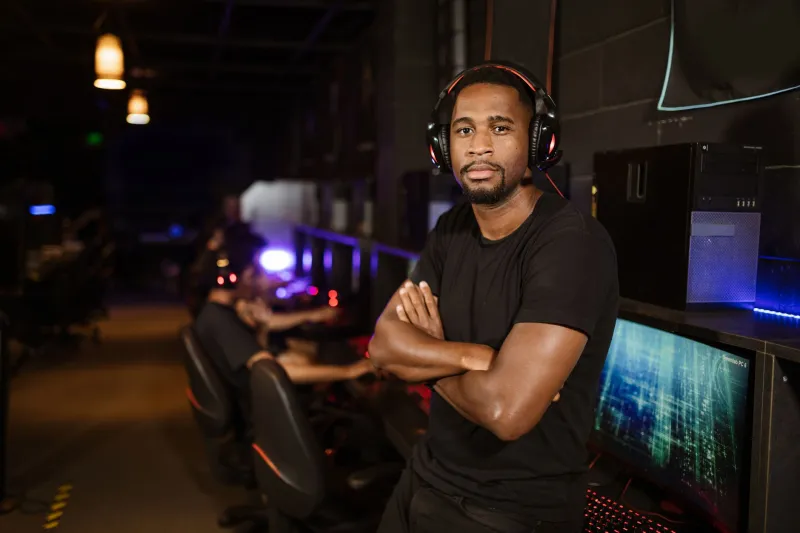
Ask most people what they think of when they hear "online gamer" and you'll probably get a pretty predictable picture. Someone parked on a couch, snacks within reach, not exactly engaged with the finer points of career development or financial planning.
But here's the thing — that stereotype is increasingly out of step with reality. A growing number of researchers, educators, and frankly just regular people who game are noticing something interesting: the mental habits you build through strategic online entertainment don't stay at the screen. They follow you into job interviews, budget spreadsheets, and high-pressure decisions.
We talked to players in the CaCuoc68 community and looked at what the research actually says. The results might surprise you.
Probability Isn't Just for Mathematicians
One of the quieter skills that gaming builds — almost without you noticing — is a working intuition for probability. Not the textbook kind where you're scribbling formulas, but the practical kind where you're making fast assessments about risk and likelihood under real conditions.
When you're deciding whether to push forward or hold back based on incomplete information, you're doing something cognitively complex. You're weighing odds, factoring in what you know and don't know, and making a call. Do that hundreds of times across dozens of sessions, and the mental muscle gets pretty well-developed.
Dr. Rachael Simmons, a cognitive psychologist who has studied decision-making in game environments, describes it this way: "Repeated exposure to probabilistic decisions — especially in contexts where feedback is immediate — accelerates the development of intuitive risk assessment. That's a transferable skill."
Alex M., a 34-year-old sales manager from Dallas and a regular on CaCuoc68, says gaming literally changed how he thinks at work. "I'm constantly reading situations, figuring out when to push a deal and when to pull back. I'd be lying if I said gaming didn't sharpen that. You learn to read the room — or in this case, the screen — really fast."
Emotional Regulation Under Pressure
Here's one that doesn't get talked about enough: gaming, especially when stakes feel real, is an emotional workout.
Anybody who's been on a hot streak that suddenly reversed knows the feeling — the spike of frustration, the urge to react, the temptation to make a move you know isn't smart just to feel like you're doing something. Learning to sit with that discomfort and make a clear-headed call anyway? That's emotional regulation. And it's one of the most sought-after qualities in high-performing professionals.
Studies from the University of Rochester have found that certain types of gaming environments actually improve players' ability to manage stress responses and maintain focus during complex tasks. The key factor seems to be the combination of high stakes (within the game context) and immediate consequences — a setup that forces the brain to practice staying calm.
Tanya W., a nurse from Seattle who games in her off hours, puts it plainly: "My job is literally about staying calm when everything is going wrong. I'm not saying gaming trained me for the ICU — but the mental discipline of not panicking when things go sideways? I practice that more than people think."
Pattern Recognition: The Skill That Shows Up Everywhere
Strategic gaming is, at its core, a pattern recognition exercise. You're constantly observing what's happening, comparing it to what you've seen before, and adjusting your approach accordingly. Over time, this builds a kind of cognitive agility that's surprisingly portable.
Financial analysts, engineers, project managers — these are roles that reward the ability to spot meaningful signals in noisy environments. And while gaming obviously isn't a substitute for professional training, the underlying cognitive habit of looking for patterns and testing hypotheses? That transfers.
Researchers at Queen Mary University of London found that players of certain strategy-based games demonstrated significantly faster and more accurate performance on cognitive flexibility tasks compared to non-players. The study suggested that gaming may actually expand working memory capacity and the ability to switch between mental frameworks quickly.
For James P., a 29-year-old data analyst from Austin, the connection feels personal. "I work with large datasets all day. The ability to scan for anomalies, to notice when something doesn't fit the expected pattern — I genuinely think years of strategic gaming helped wire my brain for that. I can't prove it, but I feel it."
Risk Evaluation as a Life Skill
One of the most direct translations from gaming to real life is risk assessment — specifically, the ability to evaluate a situation and decide how much to commit based on the available information.
This shows up in personal finance all the time. Knowing when to hold cash versus invest, when to take a career risk versus stay put, when a deal is worth pursuing versus walking away — these are all versions of the same fundamental calculation that experienced players make dozens of times per session.
Financial planner and part-time gamer Olivia R. from Miami describes it this way: "I work with clients who are paralyzed by financial decisions because they can't tolerate uncertainty. Experienced gamers tend to be different. They've learned to act on incomplete information without freezing up. That's a huge advantage."
She's quick to add that gaming isn't a financial education replacement — but as a tool for building comfort with risk and uncertainty? She's seen it make a real difference.
Rewriting the Stereotype
None of this is to say that gaming is some kind of secret productivity hack or that every hour at the screen is secretly a masterclass in professional development. Balance matters. Intentionality matters. The difference between mindless play and engaged, strategic entertainment is real.
But the old narrative — that gaming is purely escapist, a way to check out rather than check in — doesn't hold up under scrutiny anymore. The players who approach their sessions with curiosity and strategy are building something. They're just building it in a way that doesn't always look like work.
At CaCuoc68, we've always believed that playing smart matters — not just for what happens in the game, but for the kind of thinking it develops over time. The screen is just the starting point. What happens in your head while you play? That goes a lot further.