Strangers Who Game Together: The Unlikely Friendships Redefining What It Means to Belong Online
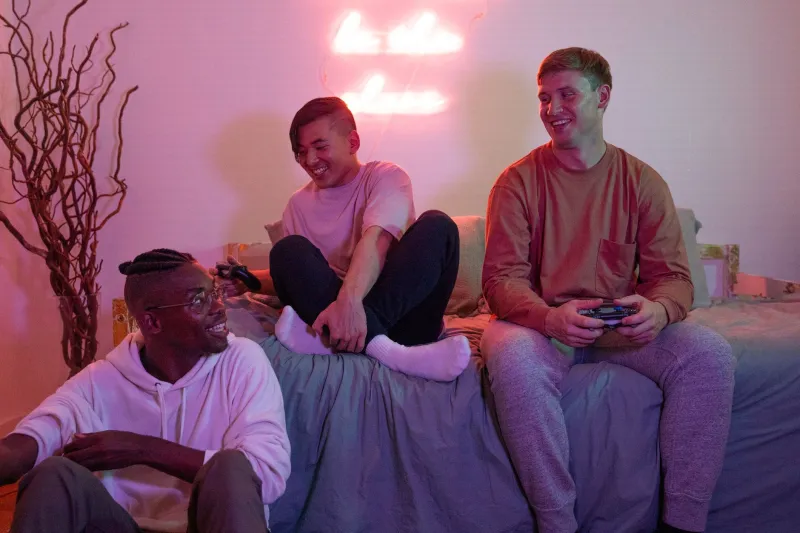
There's a 67-year-old retired electrician in rural Ohio named Dale who has a standing Tuesday night game session with a 22-year-old graphic design student from Los Angeles named Priya. They've never met in person. They live completely different lives. And according to both of them, their weekly sessions are one of the highlights of their week.
"She explains memes to me. I explain how to fix a carburetor," Dale says, laughing. "I don't know how it works, but it works."
This is the part of online gaming that nobody put in the brochure.
For years, the cultural conversation around gaming was dominated by two images: the antisocial teenager in a dark bedroom, and the hypercompetitive pro grinding for prize money. But somewhere between those two extremes — quietly, organically, without much fanfare — online gaming communities became something genuinely remarkable. They became places where people actually connect.
The Social Layer Nobody Predicted
When you strip away the scoreboards and the mechanics, what most people are actually doing when they game online is hanging out. They're chatting. They're laughing at bad luck and celebrating good runs. They're showing up for each other in the small, consistent ways that build real familiarity over time.
That's not a bug in the system. Increasingly, researchers and social scientists are recognizing it as one of online gaming's most significant features.
A 2023 study from the American Psychological Association found that a substantial portion of adults who play online games regularly report that those communities provide a meaningful source of social support — comparable in some cases to relationships formed in traditional social settings. For people dealing with isolation, social anxiety, or simply the logistical difficulty of maintaining friendships in a busy adult life, that's not a small thing.
"The barrier to entry for connection is lower in a game," explains one community researcher who studies digital social behavior. "You have a shared activity, a shared goal, a shared language. That scaffolding makes it easier for people who might otherwise struggle with small talk to actually build something real."
Cross-Demographic Friendships in the Wild
What makes gaming communities genuinely unusual — and genuinely interesting — is who ends up in them together.
In almost any other social context, a retired tradesman and a college student probably don't become friends. Their paths don't cross. Their social circles don't overlap. The geography and the life stage and the cultural references are all different. But in a shared gaming space, none of that is the first thing you encounter. The first thing you encounter is: this person plays like I do. This person gets it.
From there, real conversation tends to follow.
Jamila, a 41-year-old nurse from Houston, describes finding her closest gaming friends during a particularly brutal stretch of night shifts during the pandemic. "I'd get home exhausted and just... not want to be alone with my thoughts. I started playing, started chatting, and these people just showed up for me. We still talk every week. One of them flew in for my birthday last year."
Those stories aren't rare anymore. They're becoming almost commonplace among people who've spent meaningful time in online gaming communities.
What Good Platforms Make Possible
None of this happens in a vacuum. The quality of the community that forms around a platform is shaped, in large part, by how that platform is built and what it prioritizes.
The best gaming and entertainment platforms — the ones that actually foster connection rather than just traffic — tend to share a few things in common. They make it easy to find people with similar play styles and interests. They create spaces for conversation beyond the game itself. They treat players like people rather than data points, and they build cultures where showing up consistently is rewarded.
CaCuoc68 was built with exactly that philosophy in mind. The goal was never just to be a place where games happen — it was to be a place where a community happens to play games. There's a difference, and players feel it.
Entertainment That Gives Back
Here's the shift that's worth naming directly: for a lot of Americans, traditional entertainment has become increasingly passive. You watch something. You scroll something. You consume, and then it's over, and you're more or less where you started.
Online gaming communities offer something different. They offer reciprocity. You show up, you contribute, you become a known quantity to other people. You have inside jokes and shared histories and people who notice when you're not around.
That's not just entertainment. That's belonging.
And in a country where loneliness has been declared a genuine public health concern — the U.S. Surgeon General issued an advisory on the epidemic of loneliness in 2023 — finding belonging in unexpected places matters a lot. It matters practically, and it matters emotionally.
The Future of This Thing
Dale and Priya are still playing on Tuesday nights. Jamila's birthday friend is already planning a return visit. Somewhere right now, two people who have absolutely nothing obvious in common are bonding over a shared game, and one of them is probably thinking, I didn't expect this.
That's the part of gaming culture that rarely makes headlines, but maybe it should. Because the story of online gaming in America isn't just about graphics and competition and streaming numbers. It's about what happens when you give people a low-stakes reason to show up in the same place, consistently, over time.
Spoiler: they start to care about each other.
And that, more than any leaderboard or jackpot or highlight reel, might be the most interesting thing gaming has ever produced.